Cornhusker PPD

402.564.2821
cornhusker@cppd.us
billing@cppd.us

  • About CPPD
    • Who We Are
    • Directors
    • Management
    • Public Power
    • Business Reports
    • Dues Paid
  • Billing
    • Rate Structure
    • Service Fees / Assistance Information
    • Levelized Budget Billing
    • Auto Pay
    • Your Electric Bill
    • Operation Round Up
  • Services
    • Outdoor Lights
    • Renewable Energy
      • Net Metering Annual Renewable Generation Report
      • Customer Information on Net Billing
    • Oversized Load Proof of Notification Form
    • Youth Energy Camp
  • Goodwill Fund
  • Irrigation
    • Load Control
    • Irrigation Newsletter
    • Prescriptive Irrigation Incentive
    • Irrigation Safety Tips
  • Savings / Rebates
    • Energy Cost Calculators
    • Rebate Programs
    • Building Technology Options For Your New Home
    • Household Appliances
    • Compare Heating Costs
  • Safety
    • Electrical Safety
    • Call Before You Dig
    • Step Potential
    • Safe Electricity
  • Outages
    • Power Outage
  • News
    • Job Opening
    • Newsletter

Compare Heating Costs

As you know, there are a number of ways to heat your home. All too often homeowners assume they know which heating system is the cheapest to operatewithout doing any comparisons. Congratulations!! By reading this informationyou are doing more than the average homeowner. Just by asking questions,requesting cost comparisons, doing research, and evaluating your options,you will become an educated homeowner.

Obviously, there are a number system and structure issues that influenceyour heating costs. In order to compare the different heating systems available, it’s important to look into the following three main areas.

Factors That Affect Your Heating Costs

  • The Heating Load -This is determined by the thermostat set point inside (heat) and the outside temperature (cold). Once the temperature difference from inside to outside is determined, a calculation is made to estimate the amount of (heat) lost through walls, windows, doors,floor, and ceiling areas. Heating degree days are used throughout the winter (cold) to estimate the heating cost.
  • Heating System Efficiency -With the various heating systems available, there is a broad range of heating equipment efficiencies (60 – 400%).
  • Cost of Energy -Determine what your charge for energy will be per unit: electricity,natural gas or propane.

With these factors in mind, lets look at some cost comparisons of the more popular heating systems on the market, based on the following assumptions:

  • Ranch Style House = 1,200 square feet
  • Heat Loss = 40,700 Btuh
    • Main floor = 22,500
    • Basement = 18,200
  • Insulation levels
    • Side Walls = R-21
    • Basement Walls = R-13
    • Ceiling = R-49
  • Windows and Doors occupy less than 15% of total wall area.
  • Heating Degree Days = 6500 (approximate average for Nebraska)
  • Energy Charges
    • Electricity  =  $0.07 / kWh
    • Natural Gas  =  $1.00 / Therm
    • Propane  =  $1.40 / Gallon
  • The formula used for this calculation is:

heating_cost_bar_chart

Annual Use = Heat Loss (BTUH) x Degree Days x 17
Delta T x SPF x BTU’s per unit of fuel

You owe it to yourself to make an educated decision, because you do have options and ultimately the decision you make is the one you will have to live with for years to come.
Rising Costs Drive Anticipated 2027 Electric Rate Adjustment

Cornhusker Public Power District (CPPD) anticipates an electric rate adjustment in January 2027 due to rising wholesale power costs, increasing operating expenses and the need for continued investment in our electric distribution system.

Nebraska Public Power District (NPPD), CPPD’s wholesale power provider, announced a 5.9% wholesale rate increase for 2027. When combined with changes to NPPD’s wholesale rate structure, the overall impact to CPPD is an anticipated 9.9% increase in wholesale power costs.

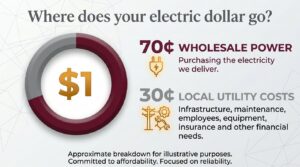
Wholesale power accounts for approximately 70% of a customer’s electric bill and represents CPPD’s largest operating expense. The 9.9% increase applies to CPPD’s wholesale power costs, not customer electric rates. CPPD anticipates its overall retail rate adjustment to our customers to be lower than the 9.9% wholesale increase, subject to board approval.

Like the customers we serve, CPPD continues to experience rising costs for materials, equipment, insurance and other essential operating expenses.

Despite these challenges, we must continue investing in our electric distribution system to maintain reliability, modernize aging infrastructure and accommodate the growing needs of our customers. Delaying these necessary investments can lead to greater costs and reliability concerns in the future.

We understand the financial pressures facing our customers and do not take rate adjustments lightly. Our responsibility is to balance rising costs and necessary infrastructure investments while keeping electric rates as reasonable as possible.

As a locally governed, not-for-profit public power district, CPPD remains committed to operating efficiently, managing costs responsibly and providing safe, reliable and affordable electricity.

Additional information regarding 2027 electric rates will be communicated following consideration and approval by the CPPD Board of Directors.

Text alert sign-up

Customers wanting to receive text alert notifications of district-wide outages sign-up by using this link.  This is not a sign-up for load control text messages. If you are interested in load control text messaging, please see below.


Contact Us

Cornhusker Public Power District
PO Box 9
23169 235th Avenue
Columbus, NE 68602-0009
Phone: 402-564-2821 or 800-955-2773
Fax: 402-564-9907
E-mail: cornhusker@cppd.us

Like Us On Facebook

Employee Login  |  Mobile App Support
Copyright © Nebraska Public Power District