Where does all that electricity go?
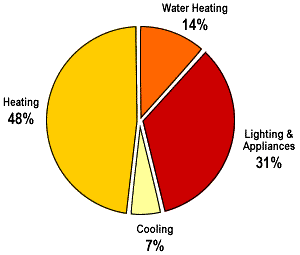 When you receive your monthly electric bill, do you know where the power was used?
This graph shows how energy is used in the average home. Your use may vary depending on your lifestyle, the size of your family and the size and age of your appliances. The amount used also varies with the weather and the seasons.
Once you have an idea how the electricity is being used, you may be able to figure out ways to cut back. Or you may find that the cost of operating all those electrical appliances and heating your hot water is worth it.
When trying to conserve energy, concentrate on the areas of large usage. In winter, heating will be over one half of the energy going into the home. The next area with the greatest potential for savings will be your hot water heater.
Compute your appliance cost
Bills are figured on your use of kilowatt hours, which are 1,000 watt hours. You can figure the cost per month for an appliance from its wattage.
For example, let’s say that all of the light bulbs in your house are 100 watts, and your family has had the lights on for a total of 200 hours last month. Multiply the 200 hours last month by the 100 watts and you have 20,000 watt hours, or 20 kilowatt hours. Multiply the 20 kilowatt hours times the cost per kilowatt hour. If each kilowatt costs 10 cents, the lights cost $2.00 for the month.
Appliances which produce heat take the most electricity. A space heater may take 1,500 watts per hour. Let’s say the heater is run four hours a day. Four times 1,500 gives us 6,000 watts per day and 180,000 watts in a 30-day month (180 kilowatt hours). Multiply the 180 kilowatt hours times 10 cents and you’ll find that it costs $18.00 to operate the space heater four a hours day for a month.
The costs computed for use are based on the energy consumed for typical appliances and the average use of the appliances. Your individual appliances and use patterns may vary, so you may want to figure exactly what it costs to operate your specific appliance. It’s not very difficult if you have the correct information.
All electrical appliances have the wattage listed somewhere on the appliance. You can use this figure to determine the cost of operation. For example, an electric space heater which lists 1,300 as the wattage, costs 13¢ per hour to operate. Here’s how that figure is reached:
Example:
1,300 watts ÷ 1,000 (watts per kWh)
1.3kWh x 10¢ per hour = 13¢ per hour
Wattage of appliance ÷ 1,000 x Hours used per month = kWh per month
To figure operating cost per month:
kWH used per month x Your cost per kWh = Operating cost per month
Thermostatically controlled appliances are not “on” 100 percent of the time. An electric oven, for example, is “on” about 50 percent of the time when baking.
Typical Operating Costs of Electric Household Appliances
|
Appliance
|
Typical
Wattage |
Estimated Hours
Used Per Month |
Estimated
Monthly kWh |
Cost Per Month
at 10¢ Per kWh |
| Air Conditioner (12,000 BTU) |
1500
|
200.0
|
300.0
|
$30.00
|
| Air Conditioner (36,000 BTU) |
4500
|
200.0
|
900.0
|
90.00
|
| Auto Engine Heater |
600
|
40.0
|
24.0
|
2.40
|
| Battery Charger (Car) |
150
|
15.0
|
2.3
|
.23
|
| Blender |
385
|
2.0
|
.8
|
.08
|
| Bug Zapper |
40
|
300.0
|
12.0
|
1.20
|
| CD, Tape, Radio, Receiver System |
250
|
60.0
|
15.0
|
1.50
|
| Clock |
3
|
730.0
|
2.2
|
.22
|
| Clothes Dryer |
5000
|
17.0
|
85.0
|
8.50
|
| Coffee Maker (Auto Drip) |
1165
|
4.0
|
4.7
|
.47
|
| Compactor |
400
|
10.0
|
4.0
|
.40
|
| Computer (With Monitor and Printer) |
365
|
75.0
|
27.4
|
2.74
|
| Convection Oven |
1500
|
8.0
|
12.0
|
1.20
|
| Curling Iron |
1500
|
5.0
|
7.2
|
.72
|
| Dehumidifier (20 Pints, Summer) |
450
|
360.0
|
162.0
|
16.20
|
| Dishwasher (Dry Cycle) |
1200
|
25.0
|
30.0
|
3.00
|
| Dishwasher (Wash Cycle) |
200
|
25.0
|
5.0
|
.50
|
| Disposal |
420
|
60.0
|
25.2
|
2.52
|
| Electric Blanket |
175
|
180.0
|
31.5
|
3.15
|
| Electric Heat (Baseboard, Furnace, Heat Pump) |
Call Cornhusker Power for a heating estimate.
|
|||
| Fan (Attic) |
400
|
71.0
|
28.4
|
2.84
|
| Fan (Ceiling) |
80
|
150.0
|
12.0
|
1.20
|
| Freezer (Automatic Defrost 15 cu. ft.) |
440
|
334.0
|
147.0
|
14.70
|
| Freezer (Manual Defrost, 15 cu. ft.) |
350
|
292.0
|
102.2
|
10.22
|
| Fry Pan |
1200
|
10.0
|
12.0
|
1.20
|
| Garage Door Opener |
350
|
3.0
|
1.1
|
.11
|
| Hair Dryer (Hand Held) |
1000
|
10.0
|
10.0
|
1.00
|
| Heat Lamp |
250
|
5.0
|
1.3
|
.13
|
| Heat Tape (30ft., Winter) |
180
|
720.0
|
129.6
|
12.96
|
| Heater (Auto Engine, Winter) |
1000
|
180.0
|
180.0
|
18.00
|
| Heater (Portable) |
1500
|
40.0
|
60.0
|
6.00
|
| Heating System (Warm Air Fan) |
312
|
288.0
|
89.9
|
8.99
|
| Humidifier (Winter) |
177
|
230.0
|
40.7
|
4.07
|
| Iron |
1000
|
5.0
|
5.0
|
.50
|
| Jacuzzi (Maintain Temperature, 2 Person) |
1500
|
93.0
|
139.5
|
13.95
|
| Lighting (Incandescent) |
75
|
100.0
|
7.5
|
.75
|
| Lighting (Fluorescent) |
40
|
100.0
|
4.0
|
.40
|
| Lighting (Compact Fluorescent) |
18
|
100.0
|
1.8
|
.18
|
| Lighting (Outdoor Floor) |
120
|
90.0
|
10.8
|
1.08
|
| Microwave Oven |
1500
|
11.0
|
16.5
|
1.65
|
| Mixer, Hand |
100
|
10.0
|
1.0
|
.10
|
| Motor (1 HP) |
1000
|
20.0
|
20.0
|
2.00
|
| Power Tools (Circular Saw) |
1800
|
1.0
|
1.8
|
.18
|
| Radio |
71
|
101.0
|
7.2
|
.72
|
| Range (Oven) |
2660
|
8.0
|
21.3
|
2.13
|
| Range (Self Cleaning Cycle) |
2500
|
3.0
|
7.5
|
.75
|
| Refrigerator/Freezer (Frostfree,17.5cu.ft.) |
450
|
333.0
|
149.9
|
14.99
|
| Satellite Dish (Includes Receiver) |
360
|
183.0
|
65.9
|
6.59
|
| Sump Pump (1/2 HP) |
500
|
20.0
|
10.0
|
1.00
|
| Television (Color, Solid State) |
200
|
183.0
|
36.6
|
3.66
|
| Toaster |
1400
|
3.0
|
4.2
|
.42
|
| Vacuum Cleaner |
1560
|
6.0
|
9.4
|
.94
|
| VCR/DVD |
21
|
12.0
|
2.5
|
.25
|
| Waffle Iron |
1200
|
4.0
|
4.8
|
.48
|
| Washer |
512
|
17.0
|
8.7
|
.87
|
| Waterbed Heater (Queen Size) |
375
|
256.0
|
96.0
|
9.60
|
| Water Heater (Quick Recovery) |
4500
|
89.0
|
400.5
|
40.05
|
| Water Pump (1/2 HP) |
460
|
41.0
|
18.9
|
1.89
|
| These figures are based on average use by a family of four at an electric rate of 10¢ per kilowatt hour. | ||||